Framing for Perspective
Prix Jean Nicod 2026 - Cycle de conférences
Le prix 2026 est décerné à Elisabeth Camp, professeure de philosophie à l'université Rutgers, à New Brunswick.
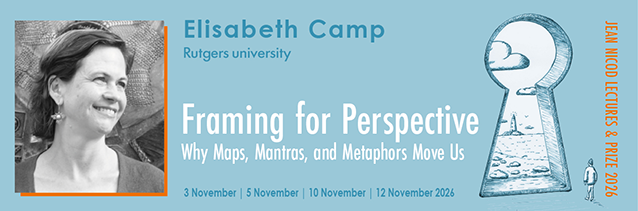
Cycle de conférences (en anglais) de Elisabeth Camp, professeure de philosophie à l'université Rutgers, à New Brunswick., lauréate du prix Jean Nicod 2026.
Elisabeth Camp a obtenu son doctorat à l’université de Californie à Berkeley, a effectué un post-doctorat à la Harvard Society of Fellows et a enseigné à l’université de Pennsylvanie avant de rejoindre l’université Rutgers en 2013. Elle a bénéficié de bourses ou occupé des postes de chercheuse invitée, notamment en tant que « Scots Philosophical Association Centenary Fellow » à l’université de Glasgow, « Burman Lecturer » à l’université d’Umeå, professeure invitée à l’Institut Jean Nicod et au sein de l’American Council of Learned Societies, entre autres.
Elle est l’auteure de plus de quarante articles en philosophie du langage, de l’esprit et de l’esthétique, ainsi que l’éditrice d’un ouvrage sur les implications philosophiques de la poésie d’Emily Dickinson. Ses recherches portent sur les pensées et les énoncés qui ne correspondent pas au modèle standard de l’esprit, considéré comme un moteur régi par des règles permettant de compiler et de transformer l’information, ni à celui du langage, vu comme un moyen d’exprimer des propositions pour partager des informations. Elle cherche à expliquer comment la cognition et le langage humains peuvent être à la fois systématiques, abstraits et conditionnés par la vérité, tout en étant variables selon le contexte, holistiques et expressifs. Ses publications récentes ont porté sur les surnoms, les étiquettes sociales et le style sociolinguistique ; les récits, l’insinuation et l’hérésie de la paraphrase ; ainsi que les cartes, les concepts et les représentations structurelles.
Programme
Framing for Perspective
Why Mantras, Metaphors and Maps Move Us
Remise du Prix Jean Nicod et cocktail après la conférence
Mardi 3 Novembre 2026 - 14h
Salle des Actes, 45 rue d’Ulm 75005 Paris
The world bombards us with information ; we must make sense of it. Philosophers and other humans accomplish this by critically interrogating hypotheses. But we also grope our way intuitively.
We explore hunches and inclinations. We try on alternate ways of being and thinking – sometimes out of curiosity or for strategic gain, but sometimes despite ourselves, while attempting to resist.
Understanding the world and each other requires deploying and modulating among perspectives : dispositions to selectively attend to, integrate, and respond to information, in virtue of a background of motivations and statistical assumptions. From the inside, perspectives appear self-justifying ; but they can produce interpretive impasses between perspectivally divergent agents who have achieved local propositional agreement. How should we decide who’s right ? In our attempts to make sense of the world and to be understood by others, we often turn to frames : expressive devices like mantras and maps that encapsulate regulative principles for intuitive interpretation. The cognitive and communicative power of such devices is puzzling on an orthodox model, which analyzes minds as proposition-compiling machines and language as a medium for exchanging propositional contents. To explain perspectives and frames, we need a more expansive and flexible understanding of how limited rational agents take in, digest, and engage with the world, and how people coordinate understanding.
Mantras for Attention
Jeudi 5 Novembre 2026 - 14h
Salle des Actes, 45 rue d’Ulm 75005 Paris
On their face, slogans like ‘It is what it is’ and ‘Boys will be boys’ flirt with vacuity : “syllables for the sake of syllables, a waste of cognition and breath,” as Frank Bruni puts it. And yet they can be powerful heuristics for handling situations that threaten to overwhelm us with informational complexity or emotional intensity. Rather than adding new information to a common ground, mantras exhort us to regulate our attention by setting expectations and focusing on what really matters. In this respect,
they pattern with labels for social kinds, which also parse information and selectively prioritize attention in generic terms. Mantras’ schematic evocativeness makes them useful tools for sca olding stability over fine-grained variations in assumptions, attitudes, and contexts. But they also leave those who don’t ‘get the gist’ out in the interpretive cold. Moreover, as they are
repeatedly re-deployed across contexts, mantras tend to lose their intuitive anchoring, becoming rigid and empty.
Metaphors for Comprehension
Mardi 10 Novembre 2026 - 14h
Salle des Actes, 45 rue d’Ulm 75005 Paris
Some mantras are metaphorical : ‘Justice is blind,’ ‘Hope is the thing with feathers.’ The threat metaphors pose to meaningfulness is less of emptiness than of seductive richness : thus, Locke calls metaphors “perfect cheats” that “insinuate wrong ideas, move the passions, and thereby mislead the judgment.” And yet, we regularly deploy them to crystallize insight and guide investigation in art, science, and life. Like stories, metaphors help us comprehend complex topics by imposing an intuitive Gestalt on a rich body of assumptions, images, and feelings. Agents seek out and maintain intuitive interpretive coherence by maximizing explanatory simplicity, marginalizing anomalies, and positing hidden connecting grounds. However, the very features that facilitate rational inquiry also perpetuate epistemic myopia and seduce us into self-perpetuating conspiracy theories.
Maps for Action
Jeudi 12 Novembre 2026 - 14h
Salle des Actes, 45 rue d’Ulm 75005 Paris
On its own, information is static. Mantras and metaphors may move us emotionally and evaluatively, insofar as they track distinctions, forge connections, and activate emotions that matter given our interests and inclinations. But understanding becomes dynamic only when we are oriented in the world. Maps can show us how to move in a literal sense, by anchoring us indexically within a holistic spatial structure that purports to mirror the target territory. At a more abstract level, scripts show us how to act by plotting paths through situations parsed in terms of roles, goals, opportunities and obstacles ; while questions show us how to inquire by plotting paths through possibility spaces structured in terms of modal accessibility.
Perspectives are not quite “maps by which we steer,” as Ramsey described beliefs. Rather, they are the base of unarticulated motivations and assumptions that generates the dynamics of cognition, disposing us to form and update complex structures which represent particular domains. We use maps and other frames to regulate those dispositions. When they work well, frames and perspectives equip us to reliably assimilate new information and to act fluidly in response to complex, changing environments. But they also trap us within simulacra that fail to fit our goals and blind us to the inaptness of those goals. We can try on new perspectives and critique our own and others’ perspectives, but we can never escape perspectives entirely. We can only grope our way toward a more robust grasp on the world.
Le Prix Jean Nicod vise à promouvoir les recherches philosophiques se rapportant à la cognition et à faire connaître en France les travaux réalisés à l’étranger dans ce domaine.
Mis à jour le 12/10/2026